
Posts

13 April 2025: Becoming the Woman I Needed: A Story of Faith, Courage and Change
My name is Jace Ekeh, and my journey to founding Strong Women Network
was born from pain, silence, and ultimately, purpose.
I was raised in a Christian home by two lovebirds, where I grew up believing in
love, faith, and commitment. I married a Pastor at 21, hopeful for a life filled with
purpose and partnership. But soon, I found myself trapped in a cycle of emotional
and physical abuse. The reality that my marriage was not going to make it was a
hard pill to swallow, even though I was suffering.
In my darkest moments, I kept asking, “Where is the woman I can talk to without judgment, without fear?” And in that season of brokenness, the Lord whispered to
my heart:
“You are the woman you’re looking for.”
That moment changed everything. What began as a desperate cry for help became
a calling. I surrendered my pain to God, and from that surrender, He birthed a
vision: Strong Women Network—a safe, healing, and Spirit-led community
for women and girls.
At first, I called it “Weak Women” because that’s what I felt like. But God began
to renew my mind and identity. He reminded me of His word: “My grace is
sufficient for you, for my power is made perfect in weakness.” (2 Corinthians
12:9). It was then I realised that true strength is not the absence of weakness but
the presence of God’s grace through it.
SWN started as a safe space for Christian women to draw strength from each other
and from God’s word, equipping them to face life’s challenges. But soon, we
began to ask the difficult questions:
Why do some women end up with abusive men?
Why do they choose to stay rather than leave?
Why is it called ambitious for a woman to want more?
And why is being ambitious a bad thing for a woman?
Who said a woman’s place is in the kitchen only?
Who made dreaming a man’s ability?
These questions led us to a deeper mission; to empower the younger generation of
girls to know better, think better of themselves, and make better choices.
As we grew, we all agreed that every woman deserves a world where she can
thrive. This became our mission, built upon seven core pillars:
-Education & Tech – Ensuring access to knowledge and digital skills.
-Skill Acquisition – Providing practical skills for economic empowerment.
-Safe Spaces – Creating communities where women can heal and grow.
-Spirituality – Grounding women in faith and inner strength.
-Health – Prioritising mental, physical, and reproductive well-being.
-Business & Finance – Equipping women with financial literacy and
entrepreneurship skills.
-Leadership – Raising strong women who lead with impact.
Today, Strong Women Network is more than a movement—it’s a commitment to
restoring the sanity, dignity, and destiny of women and girls through love, truth,
and grace.
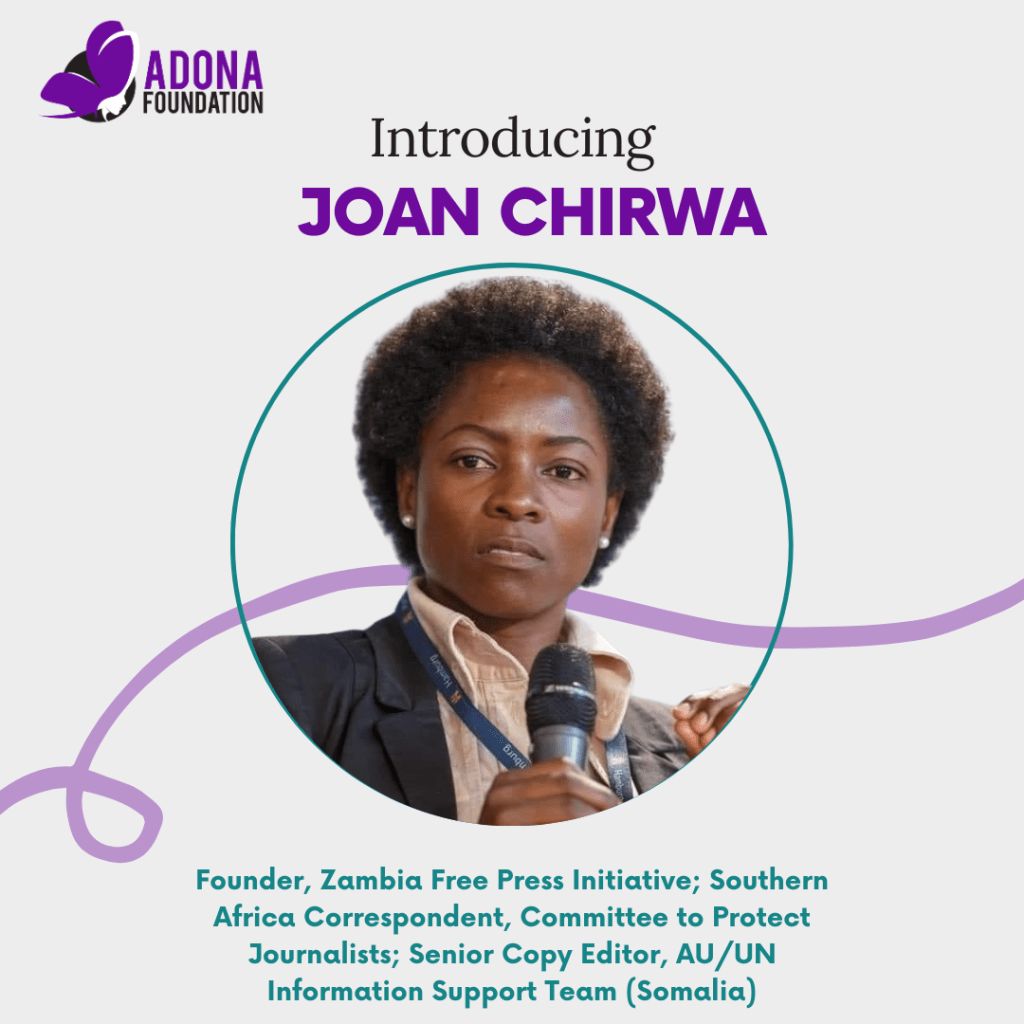
25 March 2025: From Radio to Managing Editor: A Journey of Resilience and Leadership
My love for journalism stemmed from my passion for storytelling. As a child, I would round up my siblings, mum, and dad and make them listen to me read the news to them.
My journey in journalism officially began in 1998 at Radio Chikaya in Lundazi, just after I completed my secondary education. I worked there for a year and a half before leaving Lundazi for Lusaka to secure a place at Evelyn Hone College to study journalism. By 2001, I was in class, undertaking a three-year training programme for my diploma in journalism and public relations.
Upon completion, I got a job at Breeze FM in Chipata, but I stayed for only a year because I felt radio wasn’t challenging enough. In 2005, I moved to Livingstone to work as a correspondent for The Post newspaper, which was Zambia’s largest private and independent publication at the time.
It was at The Post that I rose to the position of Managing Editor—a role I never imagined I would hold. In fact, I became the first woman to occupy that position. Sadly, I was also the last Managing Editor, as the government forcibly shut down the publication in 2016 during my tenure due to its critical reporting.
Following the closure of The Post, I helped establish The Mast newspaper in November 2016, The Post’s successor, where I served as Editor-in-Chief. I left two years later to focus on building the Zambia Free Press Initiative, which I had registered that same year.
Reflecting on my time as Managing Editor of The Post, it was one of the most challenging yet exciting and rewarding experiences of my career. It was challenging because I hardly had time for my family. I would leave home while my children were still asleep and return to find them asleep. Running a newspaper the size of The Post was no small feat. I was always the last person to leave, ensuring everything was in order before the paper went to press.
The rewards came with the privileges of the job, both within and outside the publication. However, I didn’t care much for that because I have always valued my privacy.
The biggest lesson I learned was that we have the power within us to achieve anything we set our minds to.
Additionally, I realised the importance of not letting a position define me. From the moment I was elevated to Managing Editor, I was mindful never to let the title consume me. Otherwise, moving on after the newspaper’s closure would have been difficult. I transitioned seamlessly from being an editor that many influential people wanted to associate with to being a nobody—and I loved it. I cherished the ability to return to a space where I could simply be myself, free from attention.
I love my space.

20 February 2025: Chim’s Journey of Breaking Barriers and Leading with Purpose
Born in Malawi, I’ve always had a desire to go against the grain, and my journey to leadership has been nothing short of unconventional. At a young age, my parents wanted us to get the best possible start with a good education. My sister and I were sent to Waterford Kamhlaba (WK), a United World College (UWC) school in Swaziland, now Eswatini. This experience ignited my curiosity for the world, fueling my desire to travel and explore different cultures and perspectives.
After seven transformative years at WK, I took my next bold step by moving to the UK to study Quantity Surveying at The University of Salford in a field that was predominantly male and white. I subsequently got a job with Turner & Townsend, first as a summer job, and then for my year in industry placement as part of my QS course, before being offered a permanent role following gradution.
As a Black African female, I often found myself being disregarded on projects and external meetings — many assumed I was there as admin staff or simply to take minutes, I guess due to the lack of diversity in the industry. But rather than deter me, this only fueled my determination to break barriers and prove them wrong. I went on to get my Chartered status (MRICS) as a Member of the Royal Institution of Chartered Surveyors at the age of 25.
I excelled in my career, winning several industry awards in the UK, and my persistence soon saw me rising through the ranks within Turner & Townsend. I was identified as a future leader and appointed to the Chairman’s Group, where I was given the responsibility to establish and head up the renewable energy group within the company.
In time, an opportunity arose to return to Africa, and I transitioned into a role with the UK Government Department for International Development (DFID). I started as a regional commercial advisor for DFID, working at the British High Commission in Pretoria, South Africa, before moving to the DRC at the British Embassy in Kinshasa. There I worked as a private sector development advisor, supporting companies to expand. Alongside this, I led our work in the mining sector.
In my next chapter, I moved to the Department for International Trade (DIT), which later became the Department for Business and Trade (DBT). I took on the role of Country Director for Nigeria, working across various sectors and establishing a creative sector initiative, which remains a legacy today.
I subsequently applied for a role on promotion and was promoted to Regional (Southern Africa) Director for DBT based in Johannesburg. This new role opens the door for even greater opportunities, and I am excited about what lies ahead.
Throughout all of this, I did not walk this path alone. I balanced my demanding career as a wife and mother, striving to be present in both my professional and personal life. However, my marriage broke down while I was in the DRC, a challenge that tested me in ways I had never imagined. But through it all, I remained resilient, and today, I continue to excel as a single mother, raising my beautiful and intelligent 8-year-old daughter, another future leader, who is with me here in South Africa.
Through every stage of my career, I’ve been driven by a desire to inspire and uplift others, especially young women. I’ve navigated fields where I was often the only female, the only person of color, or the one defying expectations.
My journey is proof that breaking boundaries isn’t just about being the first—it’s about leading by example, opening doors for others, and inspiring future female leaders to have the courage to defy the odds and create their own path.
I encourage every young woman to believe in her potential, embrace the challenges, and most importantly, keep pushing forward, because the world is waiting for your leadership. To all future female leaders, remember that true power lies not in conforming to the expectations of others, but in bravely forging your own path.
As a black African woman, I’ve learned that stepping outside the box, even when it feels daunting, is where you’ll discover your strength and your purpose. Embrace the challenges and the setbacks, for they will shape your resilience. Let your vision be unwavering, and your voice be unapologetically loud. We are the architects of the future — never let anyone tell you what you can or cannot achieve. Lead with courage, authenticity, and a fierce belief that you can change the world
 Adona Foundation